Arthritis Support at Home: Joint Protection, Pacing, and Practical Daily Living Supports

Andre Smith
Co-founder & CEO
Key Points
- Osteoarthritis and rheumatoid arthritis have different patterns; support planning for RA must account for the variable nature of function across flares and remission periods
- Joint protection principles taught by an OT reduce joint stress during daily tasks and slow functional decline; consistent application matters more than occasional use
- Energy conservation and pacing prevent the boom-and-bust cycle where overdoing activity on a good day causes a significantly worse period the next day
- A wide range of assistive equipment reduces joint stress in cooking, personal care, and household tasks; an OT prescribes based on the specific joints affected
- Regular low-impact exercise (hydrotherapy, walking, cycling) is one of the most effective interventions for arthritis pain and fatigue, despite the counterintuitive nature of exercising when in pain
- For people under 65 with significant functional impairment, NDIS may be the appropriate pathway; for 65 and over, My Aged Care and Medicare-funded allied health are the primary routes
Arthritis at Home: Building the Right Support
Arthritis is the leading cause of disability in Australia, affecting more than 3.6 million Australians. It encompasses over 100 different conditions affecting joints, but osteoarthritis and rheumatoid arthritis account for the large majority of people who need ongoing support in daily life.
Living well with arthritis at home requires more than pain medication. The combination of joint protection, pacing, appropriate exercise, assistive technology, and a well-matched support team makes the difference between managing the condition and being managed by it. This guide covers each of these components, the funding pathways available in Australia, and how to build a provider team suited to the specific nature and severity of your arthritis.
Understanding Your Arthritis for Support Planning
Effective support planning begins with understanding the specific characteristics of your arthritis, because these determine which strategies and supports are most appropriate.
Osteoarthritis
Osteoarthritis (OA) is a degenerative condition involving gradual breakdown of joint cartilage. Key features for support planning:
- Affects weight-bearing joints (hips, knees, spine) and finger joints most commonly
- Symptoms worsen with overuse and improve with rest, though prolonged inactivity causes stiffness
- Pain is typically activity-related in early stages, becoming more constant as the condition progresses
- Progression is gradual; significant functional change occurs over years rather than weeks
- Exercise, weight management, and joint protection slow progression and reduce pain significantly
Rheumatoid Arthritis
Rheumatoid arthritis (RA) is an autoimmune condition where the immune system attacks the synovial lining of joints. Key features for support planning:
- Can affect any joint; often symmetric (same joints on both sides)
- Morning stiffness lasting more than an hour is a classic symptom; function typically improves as the morning progresses
- Flares (periods of significantly increased inflammation, pain, and disability) are a defining feature; between flares, function may be much better
- RA causes fatigue as a systemic symptom, not just as a consequence of pain
- Disease-modifying drugs (DMARDs) and biologics can dramatically improve control; modern RA treatment is far more effective than it was 20 years ago
- Joint deformity can occur if inflammation is poorly controlled over time
Understanding which type of arthritis you have, and its current level of activity and control, is essential for planning appropriate supports.
Joint Protection: The Foundation of Daily Living
Joint protection is a set of principles and techniques for reducing stress on arthritic joints during everyday activities. Taught by an occupational therapist, these principles address how you perform tasks, not just what equipment you use.
The Core Joint Protection Principles
Use larger, stronger joints: When carrying or gripping, distribute load to the largest, strongest joints available. Carry a shopping bag on your forearm rather than gripping the handle with your fingers. Use your palms to push down on a desk when standing rather than pressing with your fingers.
Spread load across multiple joints: Use both hands for tasks where one hand would grip tightly. Hold a plate with both palms rather than gripping the edge with fingers.
Avoid sustained tight grip: Prolonged tight grip compresses finger joints and contributes to deformity in RA. Use tools with padded, ergonomic handles; take brief breaks from sustained gripping tasks.
Avoid positions of deformity: For RA particularly, avoid sustained positions that stress joints in the direction of common deformities (such as sustained wrist ulnar deviation).
Respect pain as a signal: Pain during or immediately after a task signals that the technique or tool needs to be modified. Joint protection does not mean avoiding all activity; it means modifying how activities are done.
Balance rest and activity: Neither complete rest nor sustained activity is beneficial. The balance point differs between OA (rest beneficial during acute pain) and RA (gentle movement often reduces stiffness better than rest).
Applying Joint Protection in Common Tasks
Opening jars: Use an electric jar opener or a rubber grip mat; avoid applying force through finger joints.
Cooking and kitchen tasks: Use lightweight pots and pans; rest the pot base on the stove edge when lifting rather than carrying it at arm’s length; use a trolley to move heavy items across the kitchen.
Dressing: Organise clothing to minimise bending and overhead reaching; use dressing aids to avoid fine motor strain on finger joints.
Writing and computer use: Use a pen grip sleeve to reduce the force needed for writing; adjust computer chair, keyboard, and mouse to reduce sustained wrist strain.
Energy Conservation and Pacing
Fatigue is a significant symptom for many people with arthritis, particularly RA. The tendency to push through fatigue or to overdo activity on a good day often leads to a significantly worse period the following day or week. Energy conservation and pacing strategies break this cycle.
Understanding the Boom-and-Bust Pattern
The boom-and-bust pattern is common in chronic pain and fatigue conditions: on a good day, the person does as much as possible to make up for lost time; the extra activity causes increased pain and fatigue; the person is then limited for the next several days. Breaking this pattern requires accepting that consistent moderate activity is more productive than irregular bursts of high activity.
Pacing Strategies
Activity planning: At the start of each day or week, list the tasks that need to be done and distribute them across time. Schedule demanding tasks for times when energy and joint function are typically best (for RA, mid-morning after morning stiffness has eased tends to be better than early morning or late afternoon).
Alternating tasks: Do not complete all heavy or demanding tasks consecutively. Alternate between a heavy task and a light one to allow partial recovery between demands.
Sitting where possible: Many tasks can be done seated that are habitually done standing (food preparation, ironing, folding laundry). Sitting reduces the postural demand and extends the time the task can be sustained without pain.
Planned rest breaks: Build deliberate rest breaks into the day, not just when you become exhausted. A 10-minute rest after a demanding task, before symptoms escalate, is more effective than resting after you have already pushed too far.
Splitting tasks: Tasks that cannot be completed in one sitting can be split across the day or across several days. Cleaning the bathroom does not need to be done all in one session.
Exercise: Counterintuitive but Essential
Exercise is consistently one of the best evidence-based interventions for arthritis pain and function, despite feeling counterintuitive when movement is painful. The key is choosing appropriate forms of exercise and building intensity gradually.
Why Exercise Helps
- Strengthening muscles around arthritic joints reduces the load on the joint during activity
- Aerobic exercise reduces systemic inflammation (particularly beneficial in RA)
- Regular movement reduces stiffness and maintains joint range of motion
- Exercise improves sleep quality, which in turn reduces pain sensitivity
- Exercise reduces fatigue over time (though it may increase fatigue in the short term while adapting)
Recommended Exercise Types for Arthritis
Hydrotherapy: Exercise in a warm pool is particularly effective for arthritis. Buoyancy reduces the load on weight-bearing joints; water resistance provides gentle muscle strengthening; warmth reduces stiffness and pain. Rheumatology and physiotherapy services run hydrotherapy groups. NDIS and Medicare CDM plans fund hydrotherapy.
Walking: Low-impact, accessible, free. Starting with short distances on flat terrain and building gradually. Good supportive footwear matters significantly for hip and knee OA.
Swimming: Excellent full-body conditioning with minimal joint impact.
Cycling (stationary or road): Low-impact; builds quadriceps strength which is particularly beneficial for knee OA.
Tai chi and yoga: Evidence supports both for arthritis pain and balance. Yoga modifications are needed for people with significant joint impairment; an instructor experienced with arthritis is important.
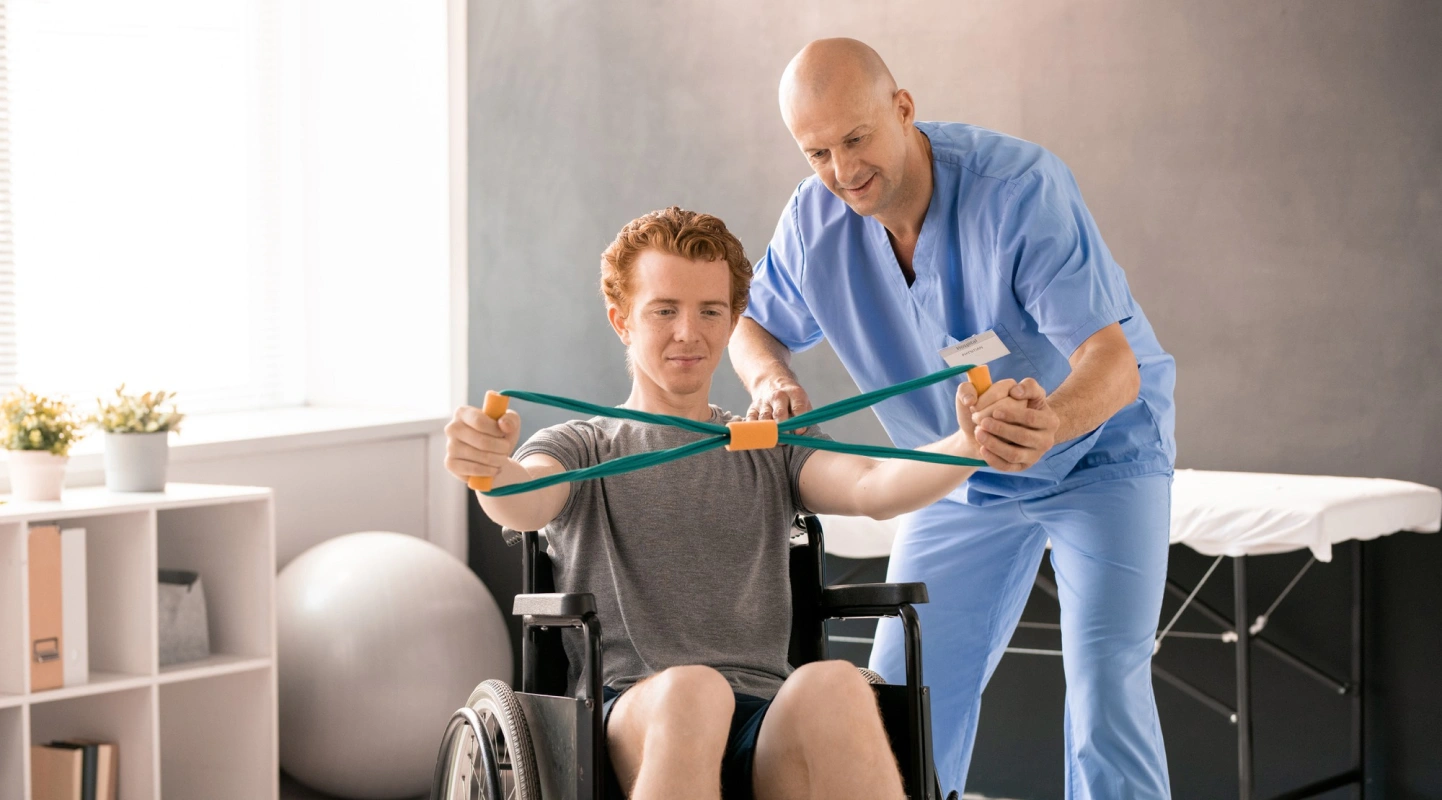
A physiotherapist prescribes an exercise program matched to the specific joints affected, the degree of impairment, and the person’s current fitness level.
Assistive Equipment
An OT assessment identifies appropriate assistive equipment for the specific functional limitations caused by the person’s arthritis. Equipment addresses the joints most affected.
Kitchen Equipment
- Lever tap adaptors: Convert round taps to lever operation; reduces wrist twisting
- Kettle tippers and water boilers: Avoid lifting a full kettle
- Electric jar and tin openers: Eliminate the grip and twist required
- Ergonomic utensils: Padded, larger handles reduce grip force
- Lightweight cookware: Titanium and non-stick coatings reduce weight
- Angled cutting boards: Spike board holds food; angled section guides knife without wrist strain
Personal Care Equipment
- Long-handled shower sponge and brush: Reach back and lower legs without bending or shoulder extension
- Shower chair or bench: Eliminates the need to stand for the full shower duration
- Grab rails: Support transfers and balance in bathroom
- Raised toilet seat: Reduces knee and hip load on sit-to-stand
- Dressing aids: Button hooks, zip pulls, long-handled shoe horn, elastic laces
General Home Equipment
- Key turner: Provides leverage for turning keys
- Lever door handles: Replace round knobs throughout the home
- Trolley or basket on wheels: Move items around the home without carrying
Home Modifications
An OT conducts a home assessment and recommends modifications appropriate to the arthritis pattern and home environment.
Bathroom: Grab rails beside the toilet and in the shower; non-slip mat; shower chair; lever taps; raised toilet seat.
Kitchen: Lever taps; accessible storage at waist height; pull-out drawers rather than deep shelves; good lighting.
Entry and garden: Handrails on all steps; ramp where feasible; non-slip path surfaces; accessible garden layout.
Bedroom: Bed at the right height for comfortable transfers (too low increases hip and knee strain on sit-to-stand); adequate space beside the bed for mobility aids.
Throughout the home: Lever handles; good lighting; remove tripping hazards; non-slip rugs or removal of rugs.
The Provider Team
| Provider | Role | Funding |
|---|---|---|
| Rheumatologist | Diagnosis, disease management medication (especially for RA) | Medicare |
| GP | Ongoing management, referrals, CDM plan | Medicare |
| Occupational therapist | Joint protection, equipment, home modification | NDIS, My Aged Care, Medicare CDM |
| Physiotherapist | Exercise program, hydrotherapy, pain management | NDIS, My Aged Care, Medicare CDM |
| Podiatrist | Foot and ankle joint care, orthotic prescription | Medicare, NDIS |
| Pain specialist | Complex pain management for severe arthritis | Medicare |
| Support workers | Personal care, domestic assistance, community access | NDIS Core, My Aged Care |
| Exercise physiologist | Long-term exercise programming | NDIS, Medicare CDM |
Key Resources
- Arthritis Australia - information, self-management programs, and community support
- My Aged Care - home support for people 65 and over (1800 200 422)
- NDIS - disability support for eligible Australians under 65 with significant arthritis-related impairment
- Occupational Therapy Australia - Find an OT directory for equipment and home modification assessment
- Physiotherapy Australia - Find a physiotherapist for arthritis exercise programs
Connecting with Arthritis Support Providers
Carevo connects people with arthritis to NDIS-registered occupational therapists, physiotherapists, and daily support providers across Australia.
Support at Home on Carevo right now
Updated 2026-06-27Most-requested Support at Home services
Based on 938 aged care and Support at Home inquiries made through Carevo. See the full Support at Home Demand Report.
Need support at home?
Find the right provider for you or your loved ones through Carevo.
About the author
Back to Blog Co-founder & CEO
Andre is the co-founder and CEO of Carevo. He holds a Bachelor of Commerce, majoring in Marketing, and a Bachelor of Arts from UNSW Sydney, where his majors were International Relations, Politics, Information Systems, and Media and Communications, graduating in 2014, and went through the UNSW 10x Founders accelerator in 2023.