Age-Related Hearing Loss: From First Signs to Hearing Support Provider Selection

Andre Smith
Co-founder & CEO
Key Points
- Age-related hearing loss (presbycusis) affects around one in three Australians over 65 and more than half of those over 75; it is permanent but highly manageable with timely intervention
- Early signs include difficulty following conversations in noise, asking for repetition, and turning television volume up; family observation is often the first alert
- The Australian Government Hearing Services Program provides subsidised hearing aids and audiology for eligible Australians (pensioners, veterans, under 26s, Aboriginal and Torres Strait Islander people) at low or no cost
- For people under 65, significant hearing loss may qualify for NDIS; for 65 and over, the primary pathways are the Hearing Services Program and My Aged Care
- Cochlear implants are an option for severe to profound loss where hearing aids provide insufficient benefit; they are funded through Medicare for eligible candidates
- Communication strategy training by an audiologist or hearing rehabilitation specialist helps both the person with hearing loss and their family and support workers
Age-Related Hearing Loss: Understanding and Acting Early
Age-related hearing loss is the gradual reduction in hearing that comes with ageing. Known clinically as presbycusis, it is the most prevalent sensory impairment in older adults and one of the most common conditions overall in Australia. Despite its prevalence, it is chronically under-recognised and under-treated: the average person waits seven to ten years between noticing hearing difficulties and seeking an assessment.
This delay has real consequences. Untreated hearing loss is associated with social withdrawal, depression, reduced quality of life, increased risk of falls (because hearing contributes to spatial awareness), and, in growing evidence, increased risk of cognitive decline. Earlier identification and intervention reduce these downstream effects.
This guide covers the early signs of age-related hearing loss, how assessment works, the funding pathways available in Australia, hearing aid and cochlear implant options, and how to choose the right provider.
Early Signs: What to Look For
Age-related hearing loss develops gradually over years, which is why it so often goes unnoticed until it is already moderate in degree. Understanding the early signs helps families and individuals act sooner.
Signs the Person Themselves May Notice
Difficulty in noise: Struggling to follow conversations at family gatherings, in restaurants, or at social events even when one-to-one conversations at home feel manageable. This is one of the most consistent early signs: high-frequency hearing loss reduces the ability to separate speech from background noise.
Asking for repetition: Regularly asking people to repeat what they said, particularly on the phone or when someone is not facing them directly.
Mishearing words: Hearing the sound of speech but not understanding the words clearly; words sound muffled or unclear rather than absent entirely.
Volume: Needing the television or radio louder than others in the household find comfortable.
Fatigue from listening: Finding conversations, particularly in noisy environments, exhausting because of the concentration required to follow speech. This listening fatigue is a recognised and underappreciated consequence of hearing loss.
Telephone difficulty: Finding the telephone harder to follow than face-to-face conversations (because lip reading cues are absent on the phone).
Signs Family Members May Notice
Family members often notice hearing loss before the person themselves does. Common patterns:
- The person does not respond when called from another room
- Conversation feels one-sided because the person is not picking up all of what is said
- The person misinterprets things said in passing
- Social events become less enjoyable or the person withdraws from them
- The person frequently responds to a different version of what was said
Both the person’s experience and family observation should be taken seriously. If any of these signs are present, an audiological assessment is the appropriate first step.
How Hearing Loss Is Assessed
The Audiological Assessment
An audiologist conducts a comprehensive hearing assessment, typically taking 60 to 90 minutes:
Pure tone audiogram: The person wears headphones and responds to tones at different frequencies and volume levels. The results are plotted on an audiogram, showing the softest sound the person can detect at each frequency. The audiogram reveals the degree and pattern of loss.
Speech discrimination testing: Beyond detecting sounds, the audiologist tests how well the person understands speech at comfortable volumes. Speech discrimination score is clinically important: two people with the same audiogram may have very different speech clarity, which affects hearing aid expectations and candidacy for cochlear implants.
Middle ear assessment (tympanometry): Tests the function of the eardrum and middle ear, distinguishing sensorineural loss (inner ear, as in presbycusis) from conductive loss (outer or middle ear, which may be reversible).
Otoscopy: Visual examination of the ear canal and eardrum; checks for wax build-up, infection, or structural issues.
The Degree of Hearing Loss
The audiogram result classifies hearing loss by degree:
| Degree | Threshold | Typical Impact |
|---|---|---|
| Mild | 26-40 dB | Difficulty in noise, quiet speech; manages in quiet |
| Moderate | 41-55 dB | Difficulty with normal speech; conversation requires effort |
| Moderately severe | 56-70 dB | Difficulty with loud speech; hearing aid strongly recommended |
| Severe | 71-90 dB | Cannot understand speech without hearing aids or cochlear implant |
| Profound | 91+ dB | Cochlear implant candidacy assessment appropriate |
Accessing Assessment
An audiological assessment can be accessed:
- Through the Australian Government Hearing Services Program (eligible clients at low or no cost)
- Through a private audiology practice (Medicare rebate with GP referral via a Chronic Disease Management plan; otherwise full fee)
- Through a hospital ENT department (public wait times; typically for complex cases)
The Australian Government Hearing Services Program
The Hearing Services Program (HSP) is the primary government-funded pathway for hearing assessment and hearing aids in Australia.
Who Is Eligible
- Holders of a Pensioner Concession Card
- Holders of a Veterans’ Affairs Gold Card or White Card (for a condition that includes hearing loss)
- People under 26 years of age
- Aboriginal and Torres Strait Islander people aged 50 and over (reduced age threshold)
- People who receive a Disability Support Pension
What the Program Covers
- Comprehensive audiological assessment
- Hearing aid fitting and prescription
- Ongoing follow-up appointments and device maintenance
- Replacement hearing aids when clinically required
How to Access
Contact an HSP-approved provider (found via the Services Australia hearing services online portal). Hearing Australia (formerly Australian Hearing) is the largest provider under the HSP and has branches in most metropolitan areas and some regional centres.
Hearing Aids
For the majority of people with age-related hearing loss, hearing aids are the primary intervention. Modern hearing aids are significantly more capable than devices of even ten years ago.
How Hearing Aids Work
Hearing aids amplify sound, but modern devices do far more than simply make everything louder. Digital processing separates speech from background noise, adjusts amplification dynamically based on the listening environment, and delivers personalised amplification matched precisely to the individual’s audiogram pattern.
Styles
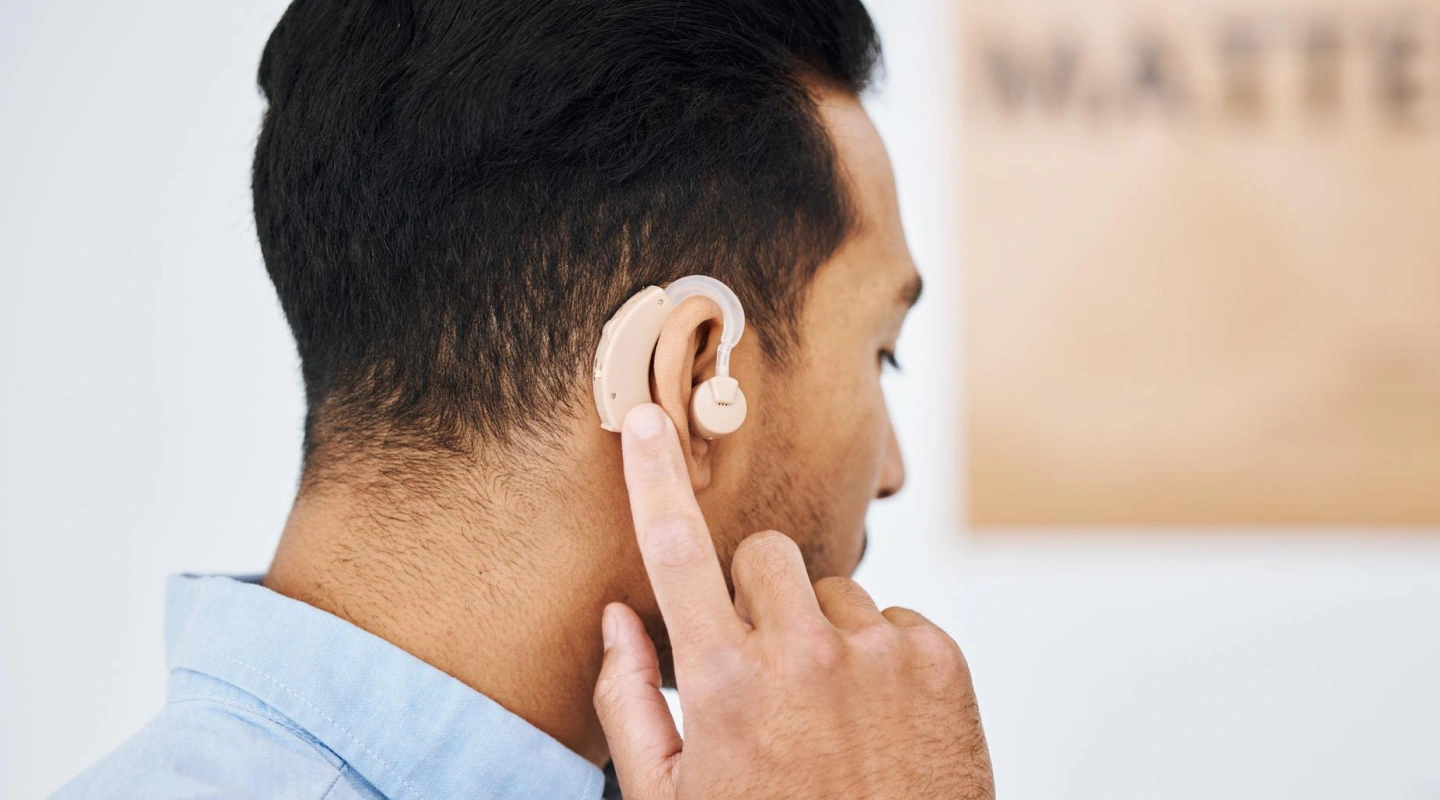
Behind-the-ear (BTE): The electronics sit behind the ear; a tube connects to an earmould or open dome in the ear canal. Suitable for all degrees of loss; easy to handle; battery compartment is accessible.
Receiver-in-canal (RIC): Similar to BTE but the receiver (speaker) sits in the ear canal; smaller and more discreet; suitable for mild to moderately severe loss. The most commonly prescribed style for age-related hearing loss.
In-the-ear (ITE): Custom-fitted to the outer ear; all electronics in the ear; larger and easier to handle than smaller custom styles. Suitable for mild to severe loss.
In-the-canal / completely-in-canal (ITC/CIC): Smaller custom devices; less visible; require good dexterity to handle. Less suitable for people with significant dexterity impairment.
Technology Features
Modern hearing aids include:
- Directional microphones: Focus on speech in front while reducing noise from sides and behind
- Bluetooth connectivity: Stream audio directly from smartphones, televisions, and other devices into the hearing aids
- App control: Adjust volume and settings via a smartphone app
- Rechargeable batteries: Avoid the need to change small batteries
- Remote microphones: A small microphone worn by a communication partner streams their voice directly to the hearing aids; very useful in noisy environments and for family members
Adjusting to Hearing Aids
Hearing aids require an adjustment period. The brain needs time to relearn how to process amplified sound, particularly after years of untreated hearing loss. The audiologist programmes the device and adjusts the fitting over multiple appointments. Consistent wear, starting in easier listening environments and progressing to more challenging ones, accelerates adjustment.
Cochlear Implants for Severe to Profound Loss
When hearing aids do not provide sufficient speech clarity despite appropriate fitting and an adequate trial period, cochlear implant candidacy should be assessed.
How Cochlear Implants Work
A cochlear implant consists of an internal component (surgically implanted by an ENT surgeon) and an external processor (worn behind the ear). The implant bypasses the damaged hair cells of the cochlea and directly stimulates the auditory nerve with electrical signals. This restores access to sound even when the cochlea has lost the hair cells that would normally transduce sound.
The Assessment Process
Cochlear implant candidacy involves:
- Audiology testing confirming severe to profound loss and poor speech discrimination with hearing aids
- ENT surgeon assessment and discussion of surgical risk
- CT or MRI imaging of the cochlea and auditory nerve
- Trial of optimal hearing aids to confirm insufficient benefit
- Multidisciplinary team review
After Surgery
Post-implant rehabilitation involves:
- Programming (mapping) sessions with an audiologist to optimise the implant’s settings
- Hearing rehabilitation to help the brain adapt to the new auditory signal
- Regular follow-up for ongoing optimisation
Cochlear implants are highly effective for appropriate candidates, including people in their 70s, 80s, and beyond. Benefits include improved speech understanding, telephone use, and quality of life.
Funding
- Medicare: Cochlear implants are MBS-funded for eligible candidates (both ears in people under 26; one ear for adults)
- Private health insurance: Many policies cover implant surgery with appropriate hospital cover
- NDIS: For eligible participants under 65
Assistive Listening Technology
Beyond hearing aids, a range of assistive listening devices supports independence in daily life.
Television streaming devices: Stream television audio directly to hearing aids via Bluetooth or a neck loop; eliminates the need to increase TV volume.
Telephone captioning: Apps and telephone services that display real-time captions of the conversation.
Alerting systems: Visual or vibrating alerts for the doorbell, telephone ring, smoke alarm, and alarm clock; important for safety when hearing aids are not worn (overnight).
Loop systems (telecoils): Many public buildings, including theatres, churches, banks, and community centres, have hearing loop (audio induction loop) systems. Hearing aids with a telecoil (T-coil) pick up the loop signal directly, significantly improving hearing in these environments.
Personal communication devices: Pocket-sized amplifiers or microphone systems for one-to-one conversations in noisy environments.
Provider Team for Hearing Loss
| Provider | Role | Funding |
|---|---|---|
| Audiologist | Assessment, hearing aid prescription, fitting, ongoing management | HSP, Medicare (with GP referral), private |
| Hearing Australia | HSP-registered assessment and device fitting | Hearing Services Program |
| ENT surgeon | Medical ear assessment, cochlear implant surgery | Medicare |
| Cochlear implant audiologist | Implant mapping and programming | Medicare, NDIS |
| Hearing rehabilitation specialist | Communication strategy training | NDIS Capacity Building, private |
| Support worker | Daily living assistance | NDIS Core, My Aged Care |
Choosing a Hearing Provider
When selecting an audiologist or hearing provider:
Check credentials: Audiologists in Australia must be members of Audiology Australia and hold the Certificate of Clinical Practice (CCP). Check registration on the Audiology Australia website.
Ask about independence: Some audiology practices are aligned with or owned by specific hearing aid manufacturers; an independent audiologist can prescribe across all brands. This is not always a problem, but knowing whether the practice is independent helps you evaluate the advice you receive.
Understand the follow-up commitment: Hearing aids require ongoing adjustments and servicing. Ask what follow-up appointments are included in the fitting fee, what ongoing costs look like, and whether telehealth follow-up is available.
Ask about trial periods: Most audiologists offer a trial period for hearing aids (typically 30 to 60 days). If the aids are not working well, adjustments or a different device should be offered within the trial period.
Consider location and access: For older Australians with limited transport, a provider who offers home visits or telehealth follow-up is important.
Key Resources
- Hearing Australia - the largest Australian Government Hearing Services Program provider; branches in most states
- Audiology Australia - Find an Audiologist directory and information for consumers
- Cochlear Ltd - information on cochlear implants and the candidacy process
- Deafness Forum of Australia - national voice for people with hearing loss, tinnitus, and deafness
- My Aged Care - home support funding for people 65 and over (1800 200 422)
- NDIS - disability support funding for eligible Australians under 65 with significant hearing loss
Connecting with Hearing Support Providers
Carevo connects people with age-related hearing loss to audiologists, cochlear implant specialists, hearing rehabilitation providers, and daily support services across Australia.
Support at Home on Carevo right now
Updated 2026-06-27Most-requested Support at Home services
Based on 938 aged care and Support at Home inquiries made through Carevo. See the full Support at Home Demand Report.
Need support at home?
Find the right provider for you or your loved ones through Carevo.
About the author
Back to Blog Co-founder & CEO
Andre is the co-founder and CEO of Carevo. He holds a Bachelor of Commerce, majoring in Marketing, and a Bachelor of Arts from UNSW Sydney, where his majors were International Relations, Politics, Information Systems, and Media and Communications, graduating in 2014, and went through the UNSW 10x Founders accelerator in 2023.