Registered Is Not the Same as Available: What Our Data Shows About CHSP Access
Andre Smith
Co-founder & CEO
People in aged care have said for years that plenty of providers are registered for the Commonwealth Home Support Programme (CHSP) but do not really take CHSP clients, because the money is thin next to a home care package. Everyone inside the sector seems to know it. Nobody publishes it, because a provider does not advertise the clients it turns down.
We run Carevo, a platform where families describe the care they need and matched providers are notified, with 72 hours to claim the request. That gave us a way to check. Between 1 April and 5 July 2026 we looked at 2,826 care requests. This is our first-party analysis of what providers actually did when we put the work in front of them.
Key findings
- Same audience, different funding. CHSP requests reached a median of 53 providers and home care package requests reached 55. For practical purposes, the same providers see both.
- 243 of 2,826 requests got nothing. Not answered late, not declined. No response at all before the 72-hour window closed.
- Providers decide fast. Median time to the first response was 2.4 minutes, and 59% of requests were claimed within five minutes. Only about 3% of notified providers claim any given request.
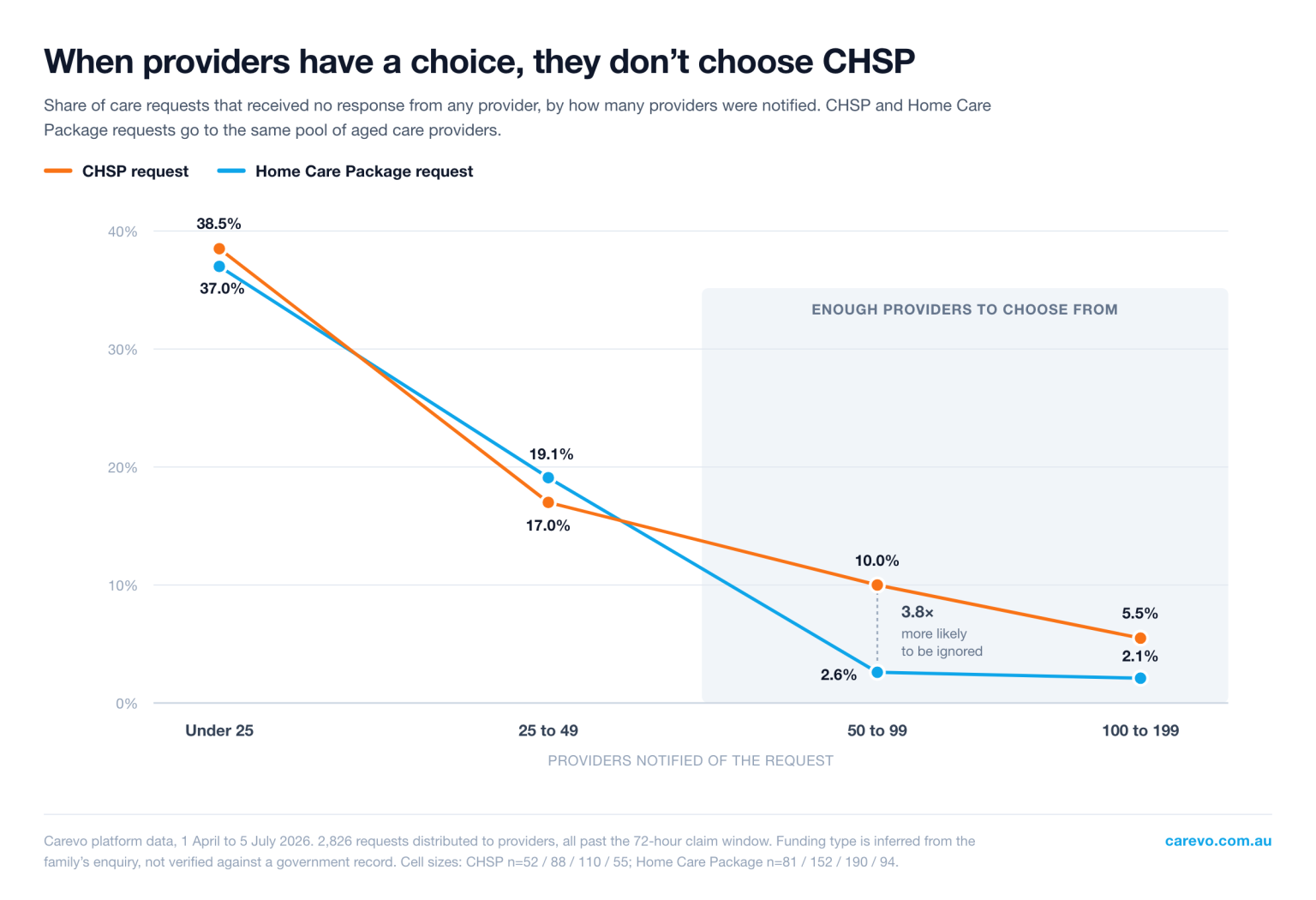
- Where providers are scarce, funding makes no difference. With fewer than 25 providers notified, 38.5% of CHSP and 37.0% of home care package requests went unanswered. Effectively identical.
- Where providers can choose, a gap opens. At 50 to 99 providers notified, 10.0% of CHSP requests went unanswered versus 2.6% of home care package requests. At 100 to 199, it was 5.5% versus 2.1%.
- Net effect: about 4x. When there are enough providers to have a choice, a CHSP client is roughly four times more likely to hear nothing back.
Why our platform can see this
When a request arrives, our matching sends it to the same pool of aged care providers whether the person is on CHSP or a home care package. Same providers, same suburbs, same email. The only thing that differs is the funding attached to the person asking.
Because the median reach was 53 providers for CHSP and 55 for a home care package, whatever happens next is not a question of who was available. It is a question of who the providers picked. Public data cannot see that. The department can tell you how many providers are registered for CHSP. It has no field for the client a provider was offered and quietly let expire.
Most requests get answered fast. 243 got nothing.
Of the 2,826 requests, 243 were never answered. Not answered late, not declined. No response at all before the window shut.
When providers did want the work, they were quick about it. The median time to the first response was 2.4 minutes, and 59% of requests were claimed within five minutes. Nobody is sitting on these for a week. A provider opens the email, reads it, and decides.
There is a smaller finding underneath that operators should sit with: of every request we send out, only about 3% of the notified providers claim it. Being quick is still the cheapest advantage on offer. Whoever opens the email in the first five minutes takes the work.
Where providers are scarce, everyone waits the same
Where only a handful of providers are within reach of a request, CHSP and home care package clients are ignored at the same rate. With fewer than 25 providers notified, 38.5% of CHSP requests went unanswered and 37.0% of home care package requests did. Effectively identical.
In those areas the funding label makes no difference, because there is genuinely nobody to take the work. Thin is thin.
Where providers can choose, CHSP clients wait
Once there are enough providers to have a choice, the two pull apart.
At 50 to 99 providers notified, 2.6% of home care package requests went unanswered, against 10.0% of CHSP requests. At 100 to 199 notified, it was 2.1% against 5.5%. Same pool, same week, same platform, and roughly four times the chance of hearing nothing back if you are the CHSP client.
The shape of that is the whole finding. Scarcity does not produce the gap. The gap opens only once providers have room to choose, and what they choose is the package.
The gap in one chart
The same numbers as a table:
| Providers notified | CHSP unanswered | Home care package unanswered |
|---|---|---|
| Under 25 | 38.5% | 37.0% |
| 25 to 49 | 17.0% | 19.1% |
| 50 to 99 | 10.0% | 2.6% |
| 100 to 199 | 5.5% | 2.1% |
Cell sizes: CHSP n = 52 / 88 / 110 / 55; home care package n = 81 / 152 / 190 / 94.
What this means, and what it does not
This does not show providers behaving badly. It shows them behaving rationally. Under Support at Home, the distance between a package client and an entry-level CHSP client, in hours and in revenue per visit, is wide enough that when both land in the same inbox at the same minute, the decision makes itself. The behaviour is not the problem. The economics underneath it are.
That leads somewhere uncomfortable for policy. If CHSP access is the goal, registering more providers will not deliver it. The providers are already registered. They are already getting the requests. They are passing on them in under three minutes. A declination problem cannot be fixed with a recruitment strategy. You have to change what a CHSP client is worth to the person making the call.
Registration is a licence. It is not a promise to answer the phone. Registered is not the same as available.
Caveats
The numbers have earned some caveats.
- Funding type is inferred. Our classifier reads it from what the family tells us, not from a verified government record.
- Our pool is a sample. It is a few thousand aged care businesses, not the whole country.
- Unanswered is not the same as unmet. A request going unanswered with us does not prove the family never found care somewhere else.
We are reporting what providers did when we put the work in front of them, and nothing beyond that. On that narrow question, the data is not ambiguous: when there is a choice to be made, the CHSP client is the one left waiting.
As featured in Inside Ageing
This research first appeared as a guest post by our co-founder and CEO, Andre Smith, in Inside Ageing: Registered is not the same as available. This page is the primary source for the underlying data and method.
How this analysis is compiled
The figures come from Carevo platform records: care requests submitted by families, the providers matched and notified for each, and whether a provider claimed the request inside the 72-hour window. Carevo is an Australian platform that connects families with aged care and disability providers. Providers pay a flat subscription and families pay nothing. Carevo does not deliver care itself.
Find the right provider through Carevo
Answer a few quick questions and get matched with providers who fit your needs. Free, no obligation.
Need Home Care Packages?
Who is the care for?
Takes 30 seconds. Free, no obligation.
Co-founder & CEO
Andre is the co-founder and CEO of Carevo. He holds a Bachelor of Commerce, majoring in Marketing, and a Bachelor of Arts from UNSW Sydney, where his majors were International Relations, Politics, Information Systems, and Media and Communications, graduating in 2014, and went through the UNSW 10x Founders accelerator in 2023.