Deaf-Blindness Support in Australia: Building a Provider Team
Gemma Foxton
Customer Lead
Key Points
- Deaf-blindness involves combined significant vision and hearing loss; the functional impact is greater than the sum of each loss individually, requiring specialist dual sensory support providers
- The core provider team includes an intervenor, an orientation and mobility specialist, a speech pathologist (for communication assessment), and often an OT; each plays a distinct and non-interchangeable role
- NDIS funds deaf-blindness supports including intervenor hours, assistive technology for both senses, home modifications, O&M training, and communication training
- The main communication methods used in Australia are tactile Auslan (hand-over-hand signing), the deafblind manual alphabet, and print on palm; the appropriate method depends on the individual’s history and residual senses
- Key Australian providers include Able Australia, Deafblind Australia, SensesWA, Deafblind Victoria, and Deaf Connect
- For progressive conditions such as Usher syndrome, starting O&M and communication training while residual vision or hearing remains produces significantly better outcomes than waiting until sensory loss is complete
Understanding Deaf-Blindness as a Distinct Disability
Deaf-blindness is not simply a combination of deafness and blindness. When both senses are significantly impaired simultaneously, the impact on daily function, communication, and community access is qualitatively different from either loss alone. The primary channels through which people receive information about their environment, communicate with others, and stay safe are simultaneously compromised.
This distinction matters for provider selection. Support workers trained only in blindness or only in deafness do not have the specialised skills to support dual sensory loss effectively. An intervenor trained in dual sensory loss is a distinct provider type.
There are two broad categories of deaf-blindness that produce different support and communication needs.
Congenital deaf-blindness is present from birth or early childhood. Causes include CHARGE syndrome (a genetic condition affecting hearing, vision, and balance among other systems), congenital rubella, and Usher syndrome Type 1 (profound hearing loss from birth, with retinitis pigmentosa causing vision loss from early childhood). People with congenital deaf-blindness have different developmental pathways: language and communication must be built from the ground up using tactile and residual sensory channels.
Acquired deaf-blindness occurs when someone who previously had functional hearing, vision, or both loses one or both senses later in life. Usher syndrome Type 2 (mild-moderate hearing loss from birth, with retinitis pigmentosa causing progressive vision loss from adolescence or early adulthood) is the most common cause. Age-related combined hearing and vision loss is another pathway. People with acquired deaf-blindness have an existing language and communication foundation to build on, which shapes the support approach differently.
The Intervenor: What This Provider Does
The intervenor is the most essential and least understood member of the deaf-blind support team. The concept was developed specifically because the standard support worker role, even when combined with sign language or visual guide skills, does not address the unique access barriers created by dual sensory loss.
An intervenor:
- Uses the person’s preferred communication method to convey environmental information (what is happening around them, who has entered the room, what is being said in a conversation, what is written on a sign)
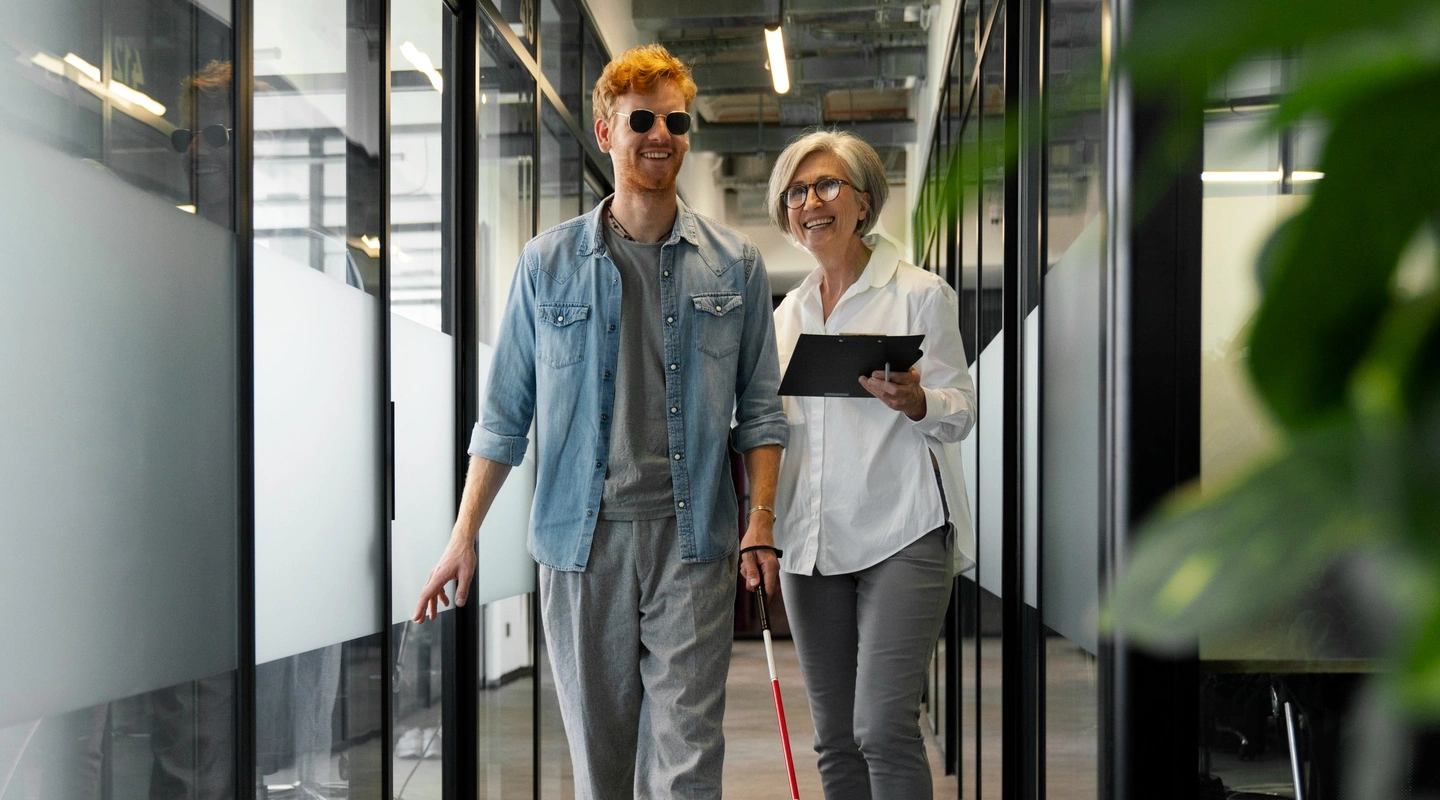
- Provides physical guidance through the environment using specialist sighted guide techniques adapted for deaf-blindness
- Facilitates participation in social situations, community activities, and daily tasks by ensuring the person has access to the information they need in real time
- Advocates within the environment to ensure the person’s communication needs are understood and respected
Intervenors require training that goes beyond what standard support workers receive. Able Australia and SensesWA train intervenors and can provide guidance on sourcing trained workers. When building an NDIS plan, the need for an intervenor should be documented by the OT and speech pathologist team, as the higher support worker rate may require justification.
Communication Methods in Australia
The choice of communication method is the most critical decision in any deaf-blind support plan. The right method depends on:
- Whether the deaf-blindness is congenital or acquired
- Whether the person has any prior sign language experience (Auslan)
- The extent and nature of residual vision (sufficient for visual frame interpreting?) and residual hearing
- The person’s preferences, established communication history, and comfort
A speech pathologist experienced in augmentative and alternative communication, working alongside a deafblind communicator, conducts the assessment. This is not a decision that can be made by family or support workers alone.
Tactile Auslan (Hand-Over-Hand Signing)
For people with prior Auslan experience, tactile Auslan is typically the most efficient method. The person places their hands over the interpreter’s or communicator’s hands and reads the signs through touch and movement. This method requires a communication partner who is fluent in Auslan and trained in tactile delivery. Able Australia offers structured deafblind communication guide training that includes tactile Auslan.
Deafblind Manual Alphabet (Tactile Fingerspelling)
The deafblind manual alphabet is based on the Auslan finger alphabet, adapted so that letters are traced or placed into the palm of the recipient’s hand. It is slower than tactile Auslan but accessible to people who do not have prior sign language experience. Each letter has a distinct touch pattern, location, and movement on the hand that can be learned systematically. This method is effective for one-to-one communication with trained family members and support workers.
Print on Palm
For people who are literate in written English, print on palm involves writing block capital letters directly onto the palm of the person’s hand. This is accessible without specialist training and can be used by anyone who knows the person. It is slower than other methods and better suited to short exchanges than extended conversation.
Visual Frame and Tracking (for Residual Vision)
For people who retain some functional vision, particularly a partial visual field, visual frame and tracking allow them to access sign language or interpreter services within their usable visual space. The interpreter positions themselves within the person’s remaining visual field. As vision narrows, the method transitions toward tactile approaches.
Braille and Electronic Communication
For written communication, braille remains relevant for people with prior braille literacy. Electronic braille displays connected to computers and smartphones extend access to digital information. Speech pathologists and assistive technology specialists assess whether braille or electronic communication tools are appropriate and achievable.
Building the Provider Team: Roles and Sequence
Step 1: Audiologist and ophthalmologist assessment
Both the vision and hearing components of the disability must be formally documented by the relevant clinical specialists. These reports are the primary evidence for NDIS access and should specify the nature of each loss, whether it is progressive, and the combined functional impact.
Step 2: Communication assessment (speech pathologist and deafblind communicator)
The speech pathologist assesses communication function, existing methods, and what the person understands and can express. Together with a deafblind communicator or specialist from Able Australia or Deafblind Australia, they establish or confirm the primary communication method and identify training needs for family members and support workers.
Step 3: OT assessment
The OT assesses daily living function, home safety, assistive technology needs, and what adaptations are required at home. For deaf-blindness, the OT also considers the impact of combined sensory loss on home navigation, safety alerts (visual door bells, tactile fire alarms), and daily tasks.
Step 4: Orientation and mobility assessment
An accredited O&M specialist assesses the person’s ability to navigate familiar and unfamiliar environments. For acquired deaf-blindness in particular, beginning O&M training while some residual vision remains is strongly advisable. Learning routes and techniques while still having partial vision produces better long-term outcomes than starting when vision is fully lost.
Step 5: Intervenor and support worker coordination
Once the communication method is established and the O&M plan is in place, an intervenor (or trained support worker for lower-complexity needs) can be matched and briefed. The intervenor must be trained in the specific communication method the person uses and understand the O&M techniques so they do not undermine the person’s established navigation strategies.
NDIS Funding for Deaf-Blindness
NDIS funds the following for people with deaf-blindness:
Core Supports: Intervenor and support worker hours for personal care, daily living, and community participation. Specialist intervenors are typically funded at higher rates than standard support workers; document this need clearly in the OT and speech pathologist reports.
Capacity Building: O&M training (under Improved Daily Living), communication skills development, support worker and family communication training.
Capital Supports: Assistive technology for vision and hearing (cochlear implant accessories, communication devices, vibrating or visual alert systems for home safety), home modifications (improved lighting, tactile navigation aids, visual alerting systems).
Support Coordination: Given the specialist and complex nature of the provider team, Support Coordination in the plan is strongly advisable. A coordinator with dual sensory loss experience can significantly reduce the time families spend searching for the right providers.
Australian Organisations and Where to Start
Able Australia: National NDIS provider with dedicated deafblind services. Offers Supported Independent Living, community participation, day programs, employment support, and the Deafblind Communication Guide training program. Starting point for most states.
Deafblind Australia (DBA): National representative and advocacy body. Maintains a services directory and can point families toward state-based providers and specialist assessors.
SensesWA (Western Australia): Over 120 years of disability services. NDIS-registered. Offers communication skills training, respite, day programs, and the annual Deafblind Camp for peer connection.
Deafblind Victoria: Operated by and for people with deaf-blindness. Majority of staff have lived experience. Provides peer support, advocacy, and information.
Deaf Connect: Operates across Queensland, New South Wales, South Australia, Victoria, Western Australia, and the Northern Territory. Whole-of-life services for deaf and hard-of-hearing Australians, including those with dual sensory loss.
For families newly navigating a deaf-blindness diagnosis, contacting Deafblind Australia first provides access to the national services directory and a starting point for identifying locally available providers.
Frequently Asked Questions
What is an intervenor and how is it different from a support worker?
An intervenor is a specialist support worker trained specifically to support people with combined hearing and vision loss. Unlike a general support worker who might assist one sensory disability, an intervenor understands how dual sensory loss creates a unique functional profile. They bridge the person’s access to information and the environment using the person’s preferred communication method, provide sighted guide support, and facilitate participation in daily life.
Does deaf-blindness automatically qualify for NDIS?
Significant combined sensory loss that substantially limits daily functioning qualifies for NDIS access. You will need documentation from both an ophthalmologist and an audiologist confirming the combined functional impact. A support coordinator with dual sensory loss experience is strongly advisable.
What communication methods are used for deaf-blindness?
The main methods in Australia include tactile Auslan (hand-over-hand signing), the deafblind manual alphabet (tactile fingerspelling), print on palm, braille, and augmentative communication devices. The appropriate method depends on whether the person has congenital or acquired deaf-blindness, their prior language experience, and the extent of residual senses.
What is the difference between congenital and acquired deaf-blindness?
Congenital deaf-blindness is present from birth or early childhood and includes CHARGE syndrome and Usher syndrome Type 1. Acquired deaf-blindness occurs when sensory loss develops later in life, as with Usher syndrome Type 2 or age-related dual sensory loss. The communication and support approach differs significantly between these groups.
Which Australian organisations specialise in deaf-blindness?
Able Australia, Deafblind Australia (national), SensesWA (WA), Deafblind Victoria (Vic), and Deaf Connect (multi-state). Each offers different services; the national services directory at Deafblind Australia is the best starting point.
What role does orientation and mobility training play?
O&M training is foundational for deaf-blindness. An accredited O&M specialist teaches safe navigation using residual senses, modified white cane use, and sighted guide protocols. For progressive conditions like Usher syndrome, O&M training should begin while some useful vision remains.
Can family members be trained as deafblind communicators?
Yes. Able Australia, SensesWA, and Deafblind Australia offer communication training programs for family members and support workers. Training family members extends communication access throughout the day beyond formal support hours.
What happens at an NDIS plan review for someone with progressive deaf-blindness?
Request an unscheduled review if function changes significantly: communication method has changed, independent navigation is no longer safe, or support intensity has increased. Updated assessments from the audiologist, ophthalmologist, and O&M specialist provide the functional evidence for a plan amendment.
Key Resources
- Deafblind Australia (national representative body and services directory)
- Able Australia Deafblind Services (national NDIS provider with communication guide training)
- SensesWA (Western Australia)
- Deafblind Information Australia (communication methods, living with deaf-blindness, service directory)
- Orientation and Mobility Association of Australasia (find accredited O&M specialists)
Carevo connects people with deaf-blindness and their families to intervenors, communication specialists, O&M providers, and NDIS-registered services across Australia. Get matched with the right provider to start building your specialist support team.
Find the right provider through Carevo
Answer a few quick questions and get matched with providers who fit your needs. Free, no obligation.
Need Support Workers?
Who is the care for?
Takes 30 seconds. Free, no obligation.
Customer Lead
Gemma is Carevo's Customer Lead. She spent several years working as a support worker before moving into concierge and partnerships roles, so she writes from the frontline of care.