Vision Impairment and Independent Living: Home Navigation, Tech Training, and Provider Matching

Gemma Foxton
Customer Lead
Key Points
- Vision impairment qualifies for NDIS when it causes permanent, substantial functional impairment; for people 65 and over, My Aged Care (Support at Home) is the primary pathway
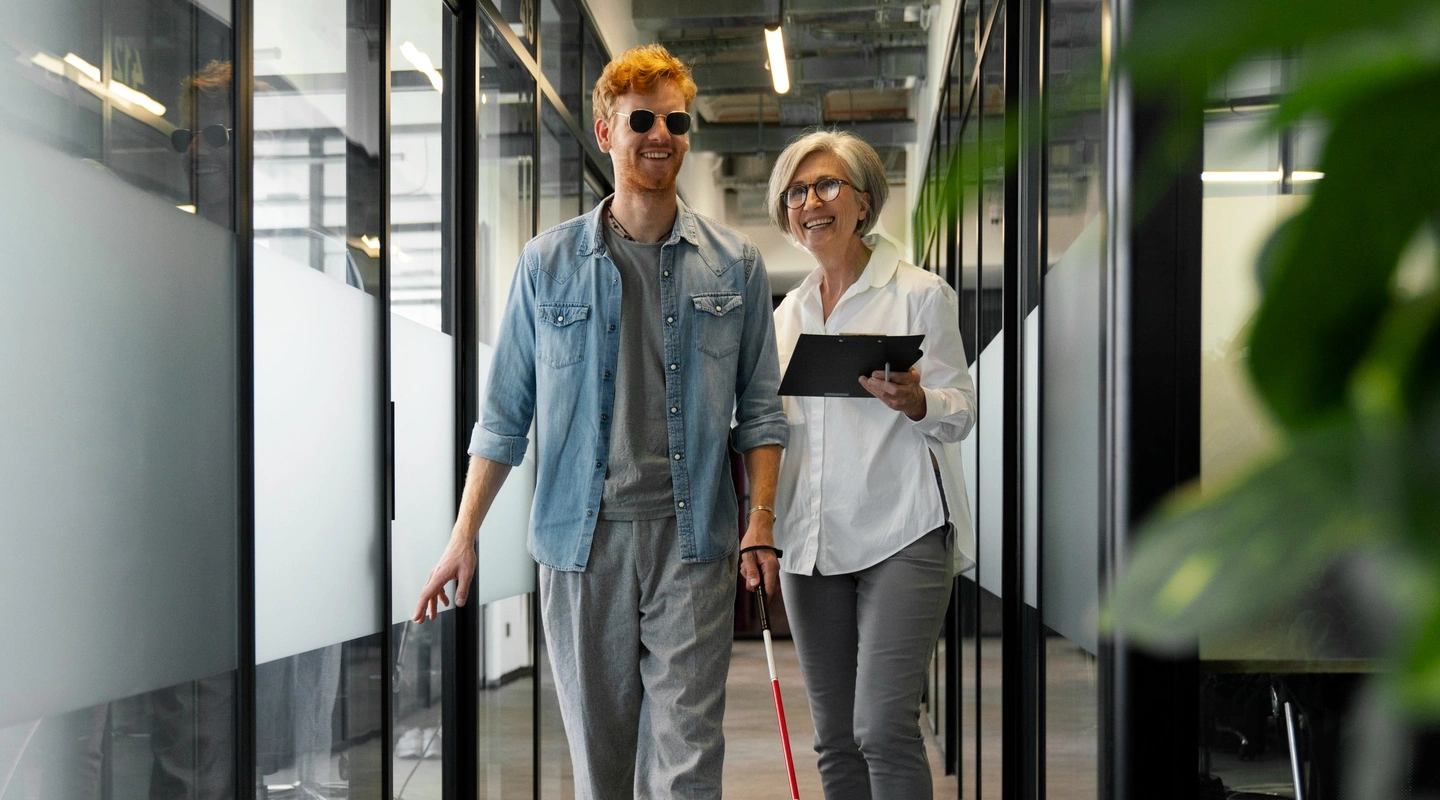
- Orientation and mobility training by an O&M specialist is the foundational independence support for vision impairment; it teaches safe home and community navigation using long cane technique, travel routes, and public transport
- Assistive technology for vision impairment ranges from optical magnifiers and large print for low vision to screen readers, Braille displays, and GPS navigation apps for blindness; NDIS funds AT prescribed by a specialist
- Home modifications for vision impairment focus on contrast, tactile markers, consistent organisation, and improved lighting rather than physical access changes
- Vision Australia is the most comprehensive national provider; services include O&M, low vision assessment, AT library, alternate format production, and peer support
- Guide dogs are suitable for highly mobile, frequent travellers; assessment through Guide Dogs Australia is comprehensive and the process takes several months
Vision Impairment and Independent Living
Vision impairment encompasses a range of conditions affecting sight, from moderate low vision to complete blindness. In Australia, approximately 575,000 people have some form of vision impairment, and this number is projected to increase as the population ages, since many causes of vision loss are age-related (macular degeneration, glaucoma, diabetic retinopathy).
Independent living with vision impairment is possible. With the right combination of skills training, assistive technology, home environment adaptations, and support services, most people with vision impairment can maintain meaningful independence in their homes and communities. The key is knowing which supports exist, how to access them, and how to build a provider team suited to the individual’s specific vision status, goals, and life situation.
This guide covers orientation and mobility, assistive technology, home modifications, the funding pathways, and the key organisations that support vision impairment in Australia.
Understanding Vision Impairment for Support Planning
Not all vision impairment is the same. Effective support planning depends on understanding the nature of the impairment.
Types of Vision Loss
Central field loss (macular degeneration, diabetic macular oedema): Loss of the central part of vision used for reading, recognising faces, and detailed tasks; peripheral vision is retained. The person may be able to navigate environments using peripheral vision but cannot read standard print or see faces clearly.
Peripheral field loss (glaucoma, retinitis pigmentosa): Loss of the outer visual field, sometimes called tunnel vision. The person may have good central acuity for reading but limited peripheral awareness, creating hazards in navigation (missing obstacles in the periphery).
General reduced acuity: Overall blurring of vision not correctable with glasses; reading and distant vision affected.
Fluctuating vision: Some conditions (diabetic retinopathy, certain retinal conditions) cause vision that varies across the day or between episodes; planning must account for the person’s worst functional state.
Congenital vision impairment: Present from birth; the person has never experienced functional sight and has developed alternative strategies throughout life.
The Low Vision Assessment
A low vision assessment by an optometrist, ophthalmologist, or low vision specialist provides:
- Measurement of visual acuity (distance and near) and visual field
- Functional assessment of how the impairment affects daily tasks
- Recommendations for optical aids (magnifiers, filters), environmental modifications, and referral to O&M and assistive technology services
Vision Australia provides low vision assessments in most states.
Orientation and Mobility Training
O&M training is the most important independence-building intervention for people with vision impairment. It teaches the person to navigate safely and confidently in their environment.
What O&M Training Covers
Long cane technique: The long white cane is the primary mobility tool for people with significant vision impairment. The O&M specialist teaches:
- The two-point touch technique (tapping the cane from side to side ahead)
- The constant contact technique (sliding the cane along the ground)
- How to detect kerbs, steps, and obstacles
- Cane use in rain, crowds, and confined spaces
Route learning: Systematically learning specific travel routes, beginning in familiar environments (home, nearby block) and extending to community travel (shops, GP, transport routes).
Indoor orientation: Navigating indoor environments (the person’s own home, workplace, or frequently visited buildings) safely and confidently without cane use where appropriate.
Road crossing and traffic management: Identifying safe crossing points, detecting vehicles, and crossing roads safely using auditory traffic cues and pedestrian signals.
Public transport: Using buses, trains, and trams safely; requesting assistance from transport staff; navigating stations and stops.
Electronic travel aids: Devices including GPS systems, obstacle detection devices, and smartphone navigation apps that complement long cane technique.
Who Needs O&M Training
O&M training is appropriate for:
- Anyone who has acquired significant vision loss and was previously sighted (needs to learn new navigation strategies)
- Children with vision impairment (early O&M develops independent travel from childhood)
- People whose vision has deteriorated to the point where existing strategies are no longer adequate
- Anyone preparing to apply for a guide dog (O&M training is a prerequisite for guide dog applications)
O&M training is provided by Vision Australia, Guide Dogs organisations, and some private O&M specialists. It is funded through NDIS Capacity Building.
Assistive Technology
Assistive technology (AT) transforms independence for people with vision impairment. The type of AT appropriate depends on the person’s vision status, goals, and digital literacy.
For Low Vision
Optical aids:
- Handheld magnifiers (pocket or illuminated): For reading labels, menus, and printed materials
- Stand magnifiers: For sustained reading tasks (mail, books)
- Electronic portable magnifiers (video magnifiers): Show a magnified camera image on a screen; adjustable magnification, contrast, and colour modes
Technology adaptations:
- Smartphone and tablet zoom and accessibility features (iOS Zoom, Display Accommodations; Android Magnification Gesture)
- Large text and bold display settings
- High-contrast display modes
- Electronic large-print books (Kindle, BARD)
For Blindness and Severe Low Vision
Screen readers:
- JAWS: Industry-standard screen reader for Windows; full-featured for complex workplace applications
- NVDA: Free, open-source Windows screen reader; widely used
- VoiceOver (Apple): Built into all Apple devices; used on iPhone, iPad, and Mac
- TalkBack (Android): Screen reader for Android devices
Screen readers convert screen content to speech or Braille output, enabling full computer, smartphone, and tablet access.
Refreshable Braille displays: Connect to a computer or device and display the screen content in Braille; enables silent reading and editing. Most useful for Braille-literate users.
GPS navigation apps:
- BlindSquare: GPS app providing audio descriptions of surroundings and navigation for iPhone
- Soundscape (Microsoft): Provides an audio map of the surrounding environment
- Google Maps / Apple Maps: Both have improved accessibility features for vision impairment
Smart home technology:
- Amazon Alexa, Google Home: Voice control of smart home features, timers, calendar, shopping lists
- Smart appliances with voice control or tactile controls (accessible ovens, microwaves)
Accessible household items:
- Talking clocks, watches, thermometers, kitchen scales
- Braille measuring cups and tactile-labelled appliances
Accessing AT Through NDIS
AT for vision impairment is funded through NDIS Capital Supports (Assistive Technology category). The AT must be prescribed by an OT or specialist (O&M specialist or low vision specialist) and the prescription should link the AT to the person’s specific functional needs and NDIS goals. Vision Australia’s assistive technology service provides demonstrations, assessment, and training; they are an NDIS-registered AT provider.
Home Modifications
Home modifications for vision impairment focus on visual clarity, tactile information, and hazard reduction rather than the physical access modifications relevant to mobility impairment.
Contrast Modifications
Contrast between surfaces significantly improves navigation for people with low vision:
- Contrasting door edge strips (bright tape or painted edge) distinguishes door frames from walls
- Contrasting step edge marking (bright tape on the leading edge of each step)
- Contrasting light switch surrounds (when the switch plate is the same colour as the wall, it is invisible to a person with low vision)
- Contrasting toilet seat (dark seat against light toilet or vice versa)
- Contrasting tableware (plate colour that contrasts with food and table surface)
Lighting
Maximising and optimising lighting reduces the impact of low vision:
- Increasing overall lighting levels (brighter globes, additional lamps)
- Task lighting (directional light directly on the task being performed)
- Night lighting (motion-activated nightlights for nocturnal navigation)
- Reducing glare (which worsens some types of low vision): diffused light rather than direct bright light
Tactile Information
Tactile markers and labels provide information when vision is insufficient:
- Bump dots on appliance controls (stove, microwave, washing machine)
- Braille labels on medications, food storage, and household items
- Consistent placement: items always returned to exactly the same location (the person navigates by spatial memory, not vision)
Tripping Hazards
- Securing or removing rugs (major hazard for people navigating by cane)
- Securing electrical cords
- Furniture consistency (no unexpected repositioning)
An O&M specialist or Vision Australia rehabilitation officer conducts the home assessment and recommends modifications.
Guide Dogs
A guide dog is a deeply impactful independence tool for eligible people with vision impairment. The dog enables faster, more fluid travel in complex environments than cane travel alone.
Eligibility and assessment:
- Significant vision impairment (typically registered as legally blind in Australia)
- High level of independent mobility (the dog enhances independence; it does not create it)
- Commitment to exercising and caring for a dog (the person becomes the dog’s primary handler)
- O&M training completed (a prerequisite for guide dog application in most programs)
The application process:
- Contact the relevant state Guide Dogs organisation (Guide Dogs Australia, Guide Dogs NSW/ACT, Guide Dogs Victoria, etc.)
- Assessment by a Guide Dogs mobility instructor
- Matching with an appropriate dog
- Multi-week team training program (the person and dog train together, typically at a residential training centre)
- Follow-up support and annual reviews
Guide dogs are provided free of charge. NDIS may fund associated costs in some circumstances.
Provider Team
| Provider | Role | Funding |
|---|---|---|
| Orientation and mobility specialist | Long cane, route training, community travel | NDIS Capacity Building |
| Low vision specialist / optometrist | Low vision assessment, optical aids | Medicare, NDIS |
| Vision Australia rehabilitation officer | Home assessment, AT training, skills | NDIS, direct service |
| AT trainer | Screen reader and technology training | NDIS Capacity Building |
| Guide Dogs mobility instructor | Guide dog training and follow-up | Guide Dogs (no cost to client) |
| OT | Home modification assessment, daily living | NDIS Capacity Building |
| Support workers | Personal care, daily living assistance | NDIS Core, My Aged Care |
Key Resources
- Vision Australia - O&M, AT, low vision assessment, peer support, and radio services
- Guide Dogs Australia - guide dog programs by state
- Blind Citizens Australia - peer advocacy and national voice for blind and low vision Australians
- NDIS Assistive Technology information - official NDIS guidance on AT funding
- My Aged Care - funding pathway for people 65 and over (1800 200 422)
Connecting with Vision Impairment Support Providers
Carevo connects people with vision impairment to NDIS-registered orientation and mobility specialists, assistive technology trainers, OTs, and daily support providers across Australia.
Find the right provider through Carevo
Answer a few quick questions and get matched with providers who fit your needs. Free, no obligation.
Need Support Workers?
Who is the care for?
Takes 30 seconds. Free, no obligation.
Customer Lead
Gemma is Carevo's Customer Lead. She spent several years working as a support worker before moving into concierge and partnerships roles, so she writes from the frontline of care.